"We need a bigger scrubber."
No route dimensions, soil method, operating window, refill path, or maintenance ownership.
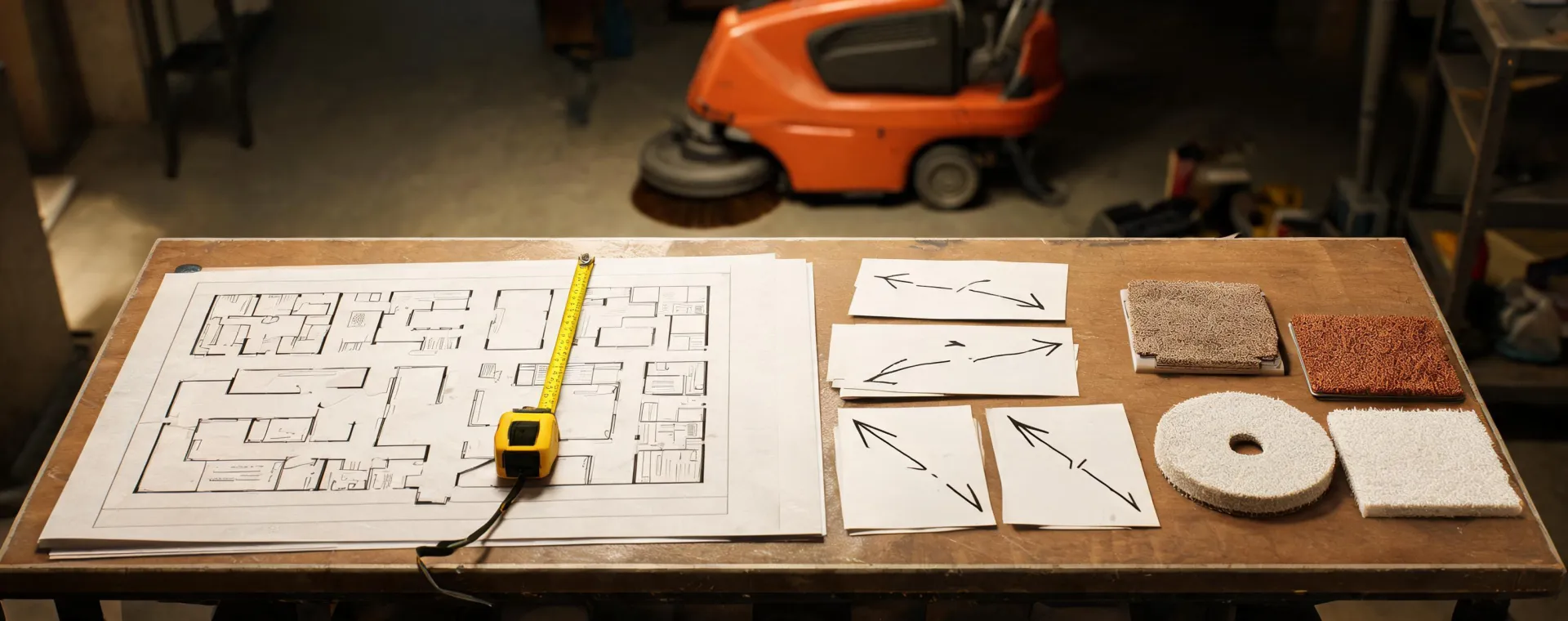
No route dimensions, soil method, operating window, refill path, or maintenance ownership.
Minimum width, representative soil, test area, power plan, route time, recovery check, and daily care steps.
The calculator converts working width, average travel speed, and an estimated utilization factor into a theoretical productive rate. Utilization accounts for turns, overlap, refill, dump, obstruction, and other non-cleaning time. It is a planning aid, not a performance guarantee.
Start conservatively. A broad open lane may support a higher utilization factor than a fixture-dense route. Do not compare two machines using different soil, pad or brush, chemistry, speed, or test boundaries.
These are transparent planning examples, not customer claims. Each shows the background, trial process, and decision record needed for a repeatable comparison.
Background: sealed concrete, long lanes, expansion joints, and tracked debris near receiving. Process: pre-sweep the same boundary, mark a 20,000 sq ft route, hold pad and chemistry constant, and record setup, cleaning, refill, dump, and post-use time separately. Decision record: water pickup at turns, debris interruptions, refill count, operator sightline, and total elapsed route time.
Background: resilient floor, fixtures, narrow turns, public-facing finish, and a 90-minute window. Process: test the tightest aisle plus an open concourse, use the approved floor-care method, and measure doorway clearance and noise at the operating position. Decision record: edge access, visible finish, recovery, maneuvering corrections, transport to storage, and time remaining for machine cleaning.
Background: joints, tracked particulate, intermittent oily soil, and traffic shared with production. Process: classify debris and residue first, determine whether pre-sweeping is required, isolate a representative zone, and follow site safety controls. Decision record: remaining film, pickup path, pad or brush condition, floor traction, component cleanup, and any condition that falls outside the proposed method.
| Variable | Hold constant | Record |
|---|---|---|
| Test boundary | Same marked route | Net floor area and constraints |
| Cleaning method | Same pad or brush, chemistry, and passes | Setup and any deviations |
| Operating pace | Comparable safe travel speed | Total elapsed and cleaning time |
| Floor condition | Comparable soil load and finish | Visible residue and water recovery |
Include the calculated baseline, route sketch, minimum clearance, actual soil, approved method, power access, and daily maintenance ownership. Model-specific specifications and manuals remain the governing source.